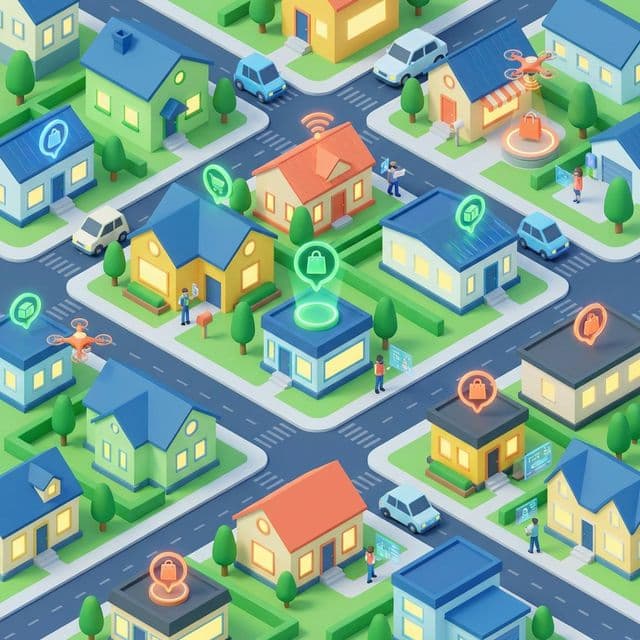
For the last decade, the 'Amazon-ification' of commerce has been the dominant trend. Everything was about global scale, centralized logistics, and massive fulfillment centers. However, a counter-movement is quietly gaining momentum. Consumers are increasingly valuing proximity, community, and speed over the convenience of a global giant. This is the era of the **Hyperlocal Marketplace**.
Velocity over Distance
Hyperlocal isn't just about 'buying local'. It's about 'buying now'. Traditional e-commerce operates on a T+1 or T+2 (days) delivery cycle. Hyperlocal operates on a T-60 (minutes) cycle. This shift requires a completely different technical stack, centered around **Geo-fencing** and **Real-time Inventory Syncing**.
Key Takeaway
The hyperlocal market is expected to grow by 18% annually through 2030, driven by the 'instant gratification' economy and a renewed focus on sustainability.
The Tech Stack of the Neighborhood
Building a hyperlocal platform requires solving the 'Three-Sided Marketplace' problem: connecting local vendors, independent logistics providers, and high-intent consumers. Our Web Designing Services focus on creating 'proximity-first' interfaces that prioritize what is closest to the user at any given micro-second.
- Geo-Spatial Databases: Using PostGIS to perform millions of proximity calculations per second.
- Dynamic Routing: AI algorithms that adjust delivery paths based on local traffic and weather in real-time.
- Tokenized Incentives: Using our Tokenized Loyalty system to reward users for choosing local vendors.
Sustainable Scaling
One of the biggest advantages of hyperlocal marketplaces is their environmental footprint. By reducing 'last-mile' travel distances and utilizing local bicycle or electric scooter couriers, these platforms are inherently more sustainable than national logistics networks. This makes them a perfect fit for our Smart Institute clients who are looking to create closed-loop economies within university campuses.
"The future of commerce isn't global; it's thousands of interconnected local nodes. The platform that wins is the one that understands the culture of the neighborhood."
— Head of Innovation, AIdeas Future Labs
Conclusion: The Power of Proximity
As we move further into 2026, the 'everything store' will face stiff competition from the 'around the corner' app. Hyperlocal marketplaces are not just a technological shift; they are a sociological one. They are rebuilding the digital fabrics of our communities, one delivery at a time.